Why Zcash is rising in 2026: 11 reasons why old altcoins are trending again

Why Zcash is back in the spotlight
In 2026, the crypto market reminded us once again that old altcoins do not always disappear forever. After a period where most attention was focused on Bitcoin, Ethereum, memecoins, and new Web3 narratives, some capital began to return to assets with a long history. One of the most notable examples has been Zcash.
The query "why is Zcash rising" did not become popular by accident. The ZEC coin combines several themes that have become relevant again: privacy, capital rotation in crypto, interest in old altcoins, and speculative movements after long periods of silence. At the time of writing, ZEC was again trading at significantly higher levels than in previous market phases, which confirms the return of attention to privacy coins.
However, it is important not to confuse market momentum with a guarantee of future growth. The cryptocurrency Zcash remains a high-risk asset: it can rise sharply on a wave of demand, but just as quickly lose its position due to volatility, regulatory pressure, or declining liquidity.
This article is for those who want to understand why the Zcash price has risen sharply, what influences the Zcash price, what risks anonymous cryptocurrencies carry, and why old coins are growing after years of silence.
What is the Zcash cryptocurrency in simple terms
Zcash is a cryptocurrency created with a focus on transaction privacy. The project was launched in 2016, and from the very beginning, it positioned itself as an alternative to open blockchains for users who value the confidentiality of financial transactions.
Unlike Bitcoin, where the transaction history is publicly available on the blockchain, Zcash privacy allows for the use of so-called shielded transactions. These can hide the sender's address, the recipient's address, and the transfer amount. This is why Zcash is often categorized as a privacy coin.
The technological foundation of Zcash is zk-SNARKs (Zero-Knowledge Succinct Non-Interactive Argument of Knowledge) — a cryptographic technology that allows one party to prove to another that a statement is true without revealing the information on which it is based. This is a cryptographic mechanism that allows for verifying the correctness of a transaction without disclosing its details. Official Zcash materials explain that shielded transactions can be encrypted on the blockchain while remaining verifiable according to the rules of the network's consensus mechanism.
In short, the network sees that the transaction is valid, but does not necessarily see who sent how much to whom. It is this property that makes the ZEC coin interesting to proponents of financial privacy — and at the same time problematic for regulatory bodies.
How Zcash differs from Bitcoin
Bitcoin and Zcash are often compared because both assets have a limited supply and originate from the early era of the crypto market. But their usage logic is different.
Bitcoin has become "digital gold" for many investors. Its main strength is high liquidity, recognition, institutional interest, and a transparent blockchain. It is this transparency that helps analytical companies track fund movements, assess wallet activity, and detect suspicious transactions.
Zcash, conversely, was created around the idea of selective privacy. A user can work with transparent or shielded addresses. This does not automatically make Zcash an "illegal" asset, but it complicates its perception by exchanges, banks, and regulatory bodies.
The main difference:
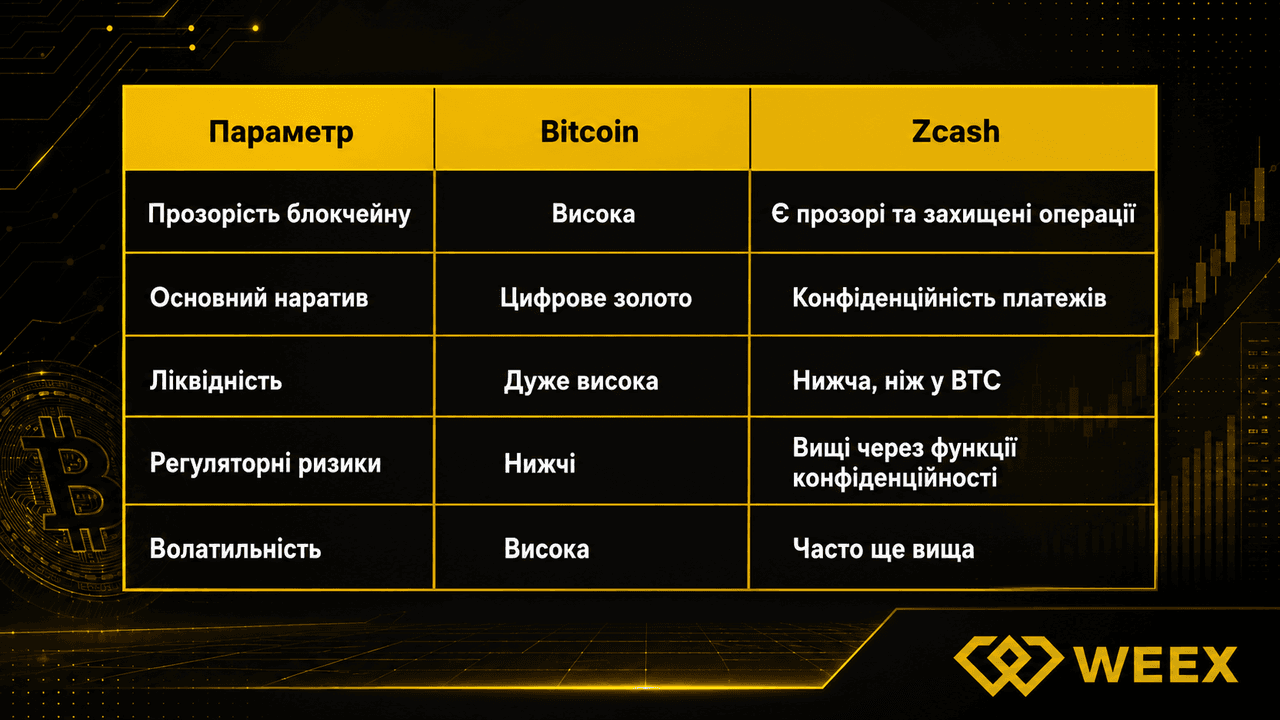
It is this difference that explains why the Zcash rate can behave more aggressively than Bitcoin's. When demand for privacy or speculative altcoins rises in the market, ZEC can receive a strong short-term impulse.
Main reasons for the Zcash price increase in 2026
The question "why has the Zcash price risen sharply" does not have one simple answer. Most often, such movements are formed at the intersection of several factors: market, liquidity, news, trader psychology, and narratives.
Capital rotation in cryptocurrencies
After significant movements in Bitcoin, some traders begin to look for assets that have not yet managed to replicate the market's growth. This is a classic capital rotation in cryptocurrencies.
The pattern often looks like this: first, the Bitcoin price rises, then attention shifts to large altcoins, and only after that does money begin to move into riskier assets. It is at this stage that old altcoins can suddenly get a second life.
Zcash fits this scenario well. It is a recognizable asset with a long history, but at the same time, it is not as overheated in the media field as some new tokens.
The return of old altcoins
Every cryptocurrency cycle has its own fashion. In one period, the market is obsessed with DeFi, in another — NFTs, memecoins, artificial intelligence, or Layer 2. But during broad speculative phases, traders often remember old altcoins.
Such assets usually include Zcash, Litecoin, Dash, Monero, XRP, EOS, and other projects that have survived several bear markets. Their advantage is recognition, trading history, exchange listings, and an established community. The downside is that some of them have an outdated narrative or weaker development activity compared to new ecosystems.
When investors ask which old altcoins might return to the trend, they are often looking not for the fundamentally best asset, but for a coin that has not yet played out the general market growth.
Interest in privacy
Zcash privacy has again become an important topic against the backdrop of increased financial monitoring, sanctions control, and regulatory pressure on the crypto sector. For some users, privacy is not an attempt to hide something, but a basic right to financial confidentiality.
At the same time, for regulatory bodies, anonymous cryptocurrencies remain a complex category. They can be used not only by ordinary users but also by participants in shadow schemes. Because of this, privacy coins are constantly between two narratives: privacy protection and compliance risks.
This conflict creates market tension. When demand for privacy grows, ZEC receives support. When regulatory pressure intensifies, risks to the price increase.
Low altcoin liquidity
Altcoin liquidity is one of the main factors for sharp movements. If an asset has a lower trading volume than Bitcoin or Ethereum, even relatively small purchases can significantly affect the price.
This is why Zcash volatility often looks aggressive. The asset can grow rapidly by tens of percent, but just as quickly lose part of that growth. For traders, this is an opportunity; for investors, it is an additional risk.
Low liquidity also increases the likelihood of short squeezes, sharp candles, and movements without obvious fundamental reasons.
Growth without crypto news
In the crypto market, it often happens that an asset grows without loud updates, partnerships, or technological breakthroughs. This phenomenon is sometimes described by traders as growth without crypto news.
In the case of Zcash, this can be explained by several factors: accumulation of positions by large players, technical breakout of levels, closing of short positions, general interest in the privacy sector, or simply FOMO.
Therefore, news about Zcash is not always the direct cause of a movement. Sometimes news appears only after the price has started to rise, and only reinforces this narrative.
FOMO and trader psychology
FOMO is the fear of missing out. In cryptocurrencies, it works especially strongly because the market moves fast, and social media instantly spreads stories about "a coin that has already done several Xs."
When traders see that the Zcash rate is rising sharply, some of them enter a position not because of deep analysis, but because of emotion. This can further amplify the movement, but it also creates the risk of a sharp pullback when the first buyers start taking profits.
How the Zcash rate reacts to the market
The Zcash rate depends not only on the project's internal factors. It is influenced by Bitcoin, general liquidity, the Fear and Greed Index, regulatory news, Zcash trading volume, and the behavior of large participants.
Zcash volatility
Zcash volatility is one of the reasons why this asset attracts the attention of traders. For short-term market participants, sharp movements can be attractive, but for investors, they mean high risk.
If the Bitcoin price falls, the ZEC price can often decline even more strongly. If the market enters an altseason phase, the ZEC price can grow faster than large assets. Such asymmetry makes the coin interesting, but it does not make it safe.
Therefore, any forecast regarding Zcash must take into account not only the potential for growth but also the possibility of deep corrections.
Zcash trading volume
Zcash trading volume helps to understand whether the movement is supported by real demand. If the price rises along with an increase in volume, this may indicate a stronger interest from market participants. If the price rises on low volume, the movement may be less sustainable.
It is also important to look at where exactly the volume is being formed: on large centralized exchanges, derivatives, or less liquid platforms. For privacy coins, this is especially important because exchange delisting of privacy coins can quickly change the asset's availability for a wide range of users.
BTC dominance and altcoins
BTC dominance and altcoins are an important link for analyzing the entire market. When Bitcoin's share in the total crypto market capitalization grows, altcoins often lag behind. When BTC dominance decreases, some capital can move to riskier assets.
What is the 2026 altseason
The 2026 altseason is a conditional period when altcoins grow faster than Bitcoin. It does not start by the calendar and does not have an official announcement. It is visible from market behavior: the number of coins outperforming BTC increases, trading volumes grow, and search queries for old coins and undervalued altcoins become more frequent.
For Zcash, such a period can be favorable. When traders are willing to take on more risk, they more often pay attention to assets with high volatility and a recognizable brand.
How Bitcoin influences ZEC
Bitcoin remains the main benchmark for the entire crypto market. If the BTC price falls sharply, most altcoins also come under pressure. If Bitcoin stabilizes after growth, the market often begins to look for the next wave among altcoins.
In such a scenario, ZEC can receive an influx of speculative capital. But if Bitcoin starts a strong downward movement again, liquidity quickly exits risky assets.
Regulatory risks of privacy coins
Regulatory risks for privacy coins are the main counter-argument against an optimistic scenario for Zcash. It is the privacy features that make the coin interesting for users that create problems for exchanges and regulators.
Exchanges and delisting of privacy coins
In various jurisdictions, exchanges have already limited or stopped supporting privacy coins. The reason is usually related to AML and KYC requirements and concerns about the use of such assets to bypass financial monitoring. In 2026, the topic of privacy token delistings remains relevant: media reported on the tightening of approaches to AML and the removal of privacy coins, including Monero, Zcash, and Dash, in certain markets.
For the price, this is important. If a major exchange limits ZEC trading, liquidity may decrease, and volatility may increase. If the asset maintains availability on major exchanges, this supports trader interest.
Crypto exchange compliance risks
Crypto exchange compliance risks lie in the fact that platforms must comply with regulatory requirements, verify customers, track suspicious transactions, and respond to sanctions lists. For transparent blockchains, this is easier because operations can be analyzed using on-chain tools.
With privacy coins, everything is more complicated. If a transaction hides important details, it is harder for an exchange to prove to a regulatory body that it is effectively controlling risks. This is why bans or restrictions on Zcash on individual exchanges remain realistic scenarios.
Sanctions risks for cryptocurrencies
Sanctions risks for cryptocurrencies have become especially important after the strengthening of global financial control. Regulatory bodies are worried that assets with high privacy can be used to bypass sanctions or hide payments.
This does not mean that every ZEC user is breaking the law. But it does mean that the privacy coin sector is under closer scrutiny. For an investor and trader, this is a risk that cannot be ignored.
What is important for Ukrainian users to know
For Ukrainian users, the issue of Zcash and privacy coins has an additional dimension. Ukraine adopted the Law "On Virtual Assets" back in 2022, but the full launch of regulation depends on tax changes and the coordination of the roles of regulatory bodies. Ukrainian legal reviews in 2026 also emphasize that the absence of a special regime does not mean the absence of tax risks: operations with crypto assets can be assessed according to general rules.
In a practical sense, this means a few things.
First, users need to monitor the position of the NBU, the Ministry of Digital Transformation, tax authorities, and relevant legislative initiatives. The crypto asset market in Ukraine is gradually moving toward more formalized regulation.
Second, operations with privacy coins may raise more questions from banks, exchanges, and payment services. Even if the coin itself is not banned, an individual platform may set its own restrictions.
Third, the tax aspect should be assessed in advance. If a user realizes profit from operations with ZEC or other crypto assets, they need to understand the potential tax consequences in their jurisdiction.
Can privacy coins be blocked
Completely blocking a decentralized network is difficult. If the blockchain is running, nodes support the network, and users have access to wallets, a technical ban becomes a difficult task.
But regulators can act differently: pressure centralized exchanges, limit fiat gateways, demand delisting, block access to services, or force platforms to tighten checks.
That is why the question is not just whether Zcash can be turned off. It is much more important whether ZEC will retain sufficient liquidity, availability on exchanges, and acceptability for infrastructure.
What influences the Zcash price
The Zcash price is influenced by several groups of factors.
Altcoin liquidity
If liquidity is high, then large orders have less impact on the market. If liquidity is low, the price reacts more sharply. For ZEC, this is especially important because privacy coins can lose or gain liquidity depending on exchange rules.
Investor sentiment
Investor sentiment in cryptocurrencies often changes faster than fundamental indicators. When greed reigns in the market, traders look for risky assets. When fear grows, they exit into Bitcoin, stablecoins, or fiat currencies.
Zcash reacts well to changes in sentiment. If the topic of privacy becomes popular, ZEC can quickly find itself in the spotlight. If the market fears regulatory pressure, the asset can come under selling pressure.
Activity of large players
The activity of large players can sharply change ZEC dynamics. If funds, large traders, or prominent market participants begin to publicly discuss Zcash, it can attract retail capital.
But there is a risk here: when growth depends on large buyers, the exit of such participants can create significant pressure on the price. Therefore, it is important not to evaluate an asset only by short-term momentum.
Which old altcoins may return to the trend
Besides Zcash, the market periodically returns to Litecoin, Monero, Dash, XRP, EOS, and other old altcoins. The reason is not always a technological breakthrough. Often it is a combination of recognition, liquidity, cycle history, and speculative demand.
Why do investors return to old coins? Because they already know these names. Old assets have historical highs around which it is easy to build a narrative: the coin is still far from its peak. But this is a dangerous logic. Just because an asset was once worth more does not guarantee a return to previous levels.
For old coins, it is important to look not only at the chart but also at real usage, development, regulatory risks, liquidity, and availability on exchanges.
Zcash price forecast: what to consider
Any Zcash price forecast for 2026 must be cautious. ZEC has strengths: recognition, history, privacy technology, connection to the zero-knowledge narrative, and the ability to react quickly to capital rotation.
But there are also weaknesses: regulatory risks of private coins, potential delistings, lower liquidity compared to Bitcoin, high Zcash volatility, and dependence on market sentiment.
An optimistic scenario is possible if the 2026 altseason continues, interest in privacy grows, and exchanges do not tighten restrictions on ZEC. A negative scenario is possible if the Bitcoin price falls sharply, regulatory bodies increase pressure on privacy coins, or major exchanges reduce support for such assets.
Therefore, Zcash should be viewed not as a guaranteed chance, but as a high-risk asset with a strong narrative and equally strong limitations.
For those who want to delve deeper into the basic concepts of the market, the WEEX Wiki has educational materials about cryptocurrencies, blockchain, trading risks, and working with digital assets.
Questions and answers
What is Zcash in simple terms
Zcash is a cryptocurrency with a transaction privacy feature. It allows users to choose between transparent and shielded transfers.
Why did the Zcash price rise sharply in 2026
The main reasons are capital rotation in cryptocurrencies, the return of old altcoins, interest in privacy, low liquidity, FOMO, and speculative demand.
How does Zcash differ from Bitcoin
Bitcoin has a transparent blockchain, while Zcash supports shielded transactions that can hide the sender, recipient, and transfer amount.
Is Zcash safe from a regulatory perspective
Zcash has increased regulatory risks due to privacy features. Safety depends on the country, exchange, method of use, and local rules.
Why do exchanges limit anonymous cryptocurrencies
Exchanges may limit privacy coins due to AML, KYC, sanctions requirements, and the difficulty of monitoring private transactions.
What influences the Zcash price
The Zcash price is influenced by Bitcoin, altcoin liquidity, Zcash trading volume, investor sentiment, activity of large players, regulatory news, and the general state of the market.
Can Zcash be banned
A complete technical ban of a decentralized network is difficult, but exchanges and regulators can introduce restrictions for Zcash, delistings, or additional checks.
Which old altcoins may return to the trend
Old altcoins often include Zcash, Litecoin, Monero, Dash, XRP, and EOS. But returning to the trend does not guarantee sustainable growth.
Conclusion
Why the Zcash price is rising in 2026 is not just a question about one coin. It is a broader story about how the crypto market returns to old narratives when the cycle phase changes.
The ZEC coin has become noticeable again due to a combination of several factors: capital rotation, interest in privacy, the return of old altcoins, FOMO, low liquidity, and attention to privacy coins. But along with the potential for growth, Zcash has serious risks: regulatory pressure, delistings, crypto exchange compliance risks, and high volatility.
That is why Zcash should be treated without euphoria. It is not a forgotten coin that will definitely return to its highs, but a complex asset at the intersection of privacy technology, market speculation, and regulatory uncertainty.
Subscribe to WEEX news to follow market updates, altcoin dynamics, and key events that may affect cryptocurrencies like Zcash.
DISCLAIMER WEEX and its affiliates provide digital currency exchange services, including derivatives and margin trading, only where such activity is legal and exclusively to appropriate users. All content is provided for reference only and does not constitute financial advice — before trading, seek advice from a financial advisor. Cryptocurrency trading is high-risk and can result in the loss of the entire investment amount. By using WEEX services, you accept all associated risks and terms. Always invest the amount you can afford to lose. Details are available in our Terms of Use and Risk Warning.