What is ZEC (Zcash)? Understanding Zero-Knowledge Proofs, the Reasons Behind the 2026 Surge, and How to Trade on WEEX

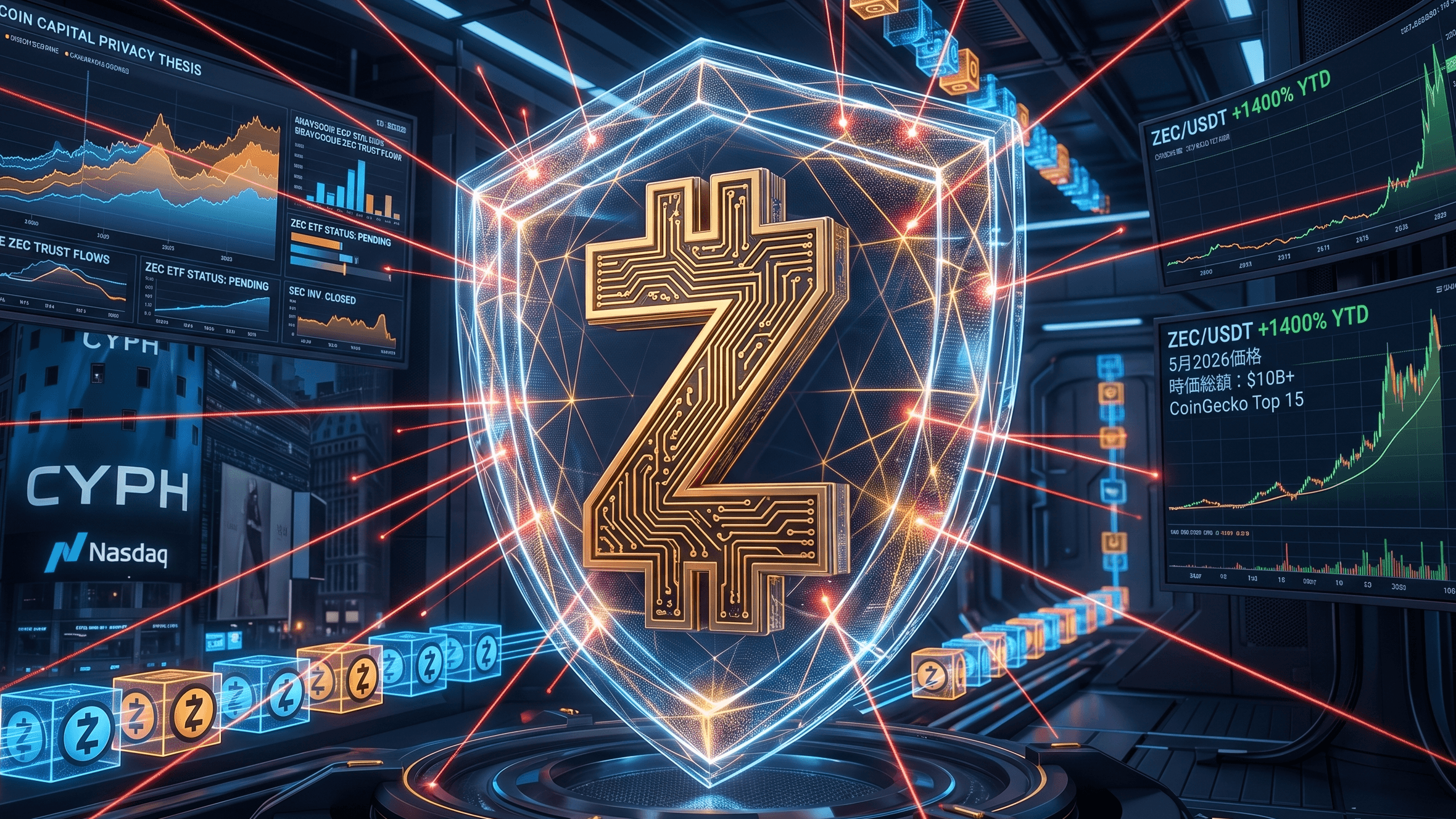
In May 2026, Zcash (ZEC) surged approximately 1,400% year-to-date, with its market capitalization climbing to around 15th place on CoinGecko. This is driven by a new investment thesis among institutional investors: "If governments can monitor and tax Bitcoin, then invisible assets are necessary."
ZEC is a privacy-focused cryptocurrency that uses a cryptographic technology called "zero-knowledge proofs (zk-SNARKs)" to hide the sender, receiver, and amount of transactions. This article explains its mechanics, the reasons for the surge, risks, and how to trade on WEEX.
What is ZEC (Zcash)?
Founded: October 2016 (by Electric Coin Company and Zooko Wilcox-O'Hearn)
Technical Foundation: Forked from the Bitcoin code, implementing zero-knowledge proofs (zk-SNARKs)
Max Supply: 21 million ZEC (same cap as Bitcoin, with halving)
Current Price: Approximately $520–$600 (as of May 2026), up approximately 1,400% year-to-date
Market Cap: Approximately $8.8–$10 billion, ranked 14th–15th on CoinGecko
Address Types: Two types: transparent addresses (t-address, public) and shielded addresses (z-address, private)
What are Zero-Knowledge Proofs (zk-SNARKs)?
The core technology of ZEC is "zk-SNARKs" (zero-knowledge proofs). In typical cryptocurrencies (like Bitcoin), transaction records are public on the blockchain, and anyone can check balances and destinations if they know the wallet address.
zk-SNARKs is a cryptographic technology that allows for the verification of a transaction's validity without revealing any details about "who sent what to whom." Simply put, it is a mechanism that "proves something is correct without revealing the content."
| Comparison Item | Bitcoin (Transparent) | ZEC (Shielded Address) |
| Sender | Public on blockchain | Private |
| Receiver | Public on blockchain | Private |
| Amount | Public on blockchain | Private |
| Transaction Validity | Verifiable | Verifiable (content private) |
Reasons for the 2026 Surge
① Multicoin Capital's "Privacy Defense" Thesis
In May 2026, the prominent crypto fund Multicoin Capital announced that it had been accumulating ZEC since February. Partner Tushar Jain argued, "Bitcoin is censorship-resistant, but balances are visible to the government. If moves like California's wealth tax (5% tax on unrealized gains) spread globally, the value of invisible assets will rise." This investment thesis spread through the market, and ZEC surged approximately 52% in 24 hours.
② Conclusion of SEC Investigation and Grayscale Spot ETF Application
On January 15, 2026, the SEC concluded its investigation into Zcash without enforcement action. This is a major turning point for ZEC, which has faced regulatory uncertainty as a privacy coin for many years. Furthermore, Grayscale has applied to convert its $137 million Zcash Trust into a spot ETF on NYSE Arca; if approved, it would be the first privacy coin ETF.
③ Winklevoss Twins Establish CYPH
The Winklevoss twins invested $50 million to establish Cypherpunk Technologies (NASDAQ: CYPH), a digital asset management firm that holds over 300,000 ZEC. The model of a NASDAQ-listed company holding ZEC as a treasury asset is similar to MicroStrategy's Bitcoin strategy.
④ Adoption of Shielded Addresses and "Encryption Supremacy"
A March 2026 report by CoinDesk Research analyzed that ZEC has reached "encryption supremacy." Transactions using shielded addresses have reached a record high of approximately 30% of the total, and the project is being re-evaluated as one capable of addressing new risks such as AI-driven on-chain behavior tracking and the threat of quantum computers.
UX improvements have also boosted adoption. Previously, using shielded addresses required a dedicated wallet, but between 2025 and 2026, mobile wallets like Zashi and cashZ adopted "shielded-by-default" designs, allowing privacy to be automatically protected during transfers without technical knowledge.
⑤ Transition from PoW to PoS and ESG Compliance
ZEC currently operates on PoW (Proof of Work), but the Electric Coin Company has specified a transition to PoS (Proof of Stake) in its roadmap for late 2026. The transition to PoS is expected to significantly reduce energy consumption, and the expectation that institutional investors who prioritize ESG (Environmental, Social, and Governance) investment criteria will find it easier to hold ZEC is one of the backgrounds supporting Grayscale's ETF application and the inflow of institutional capital.
Risks and Considerations
Regulatory Risk: Privacy coins are the category most closely scrutinized by regulators worldwide. Japan's Financial Services Agency is cautious about handling privacy coins from an anti-money laundering perspective, and there have been cases of them being delisted from domestic exchanges.
Futures-Driven Rise: The recent rise has been a leverage-driven movement where futures trading volume has surged while spot trading volume has decreased, indicating a high risk of sharp reversals and liquidations. There is a precedent from December 2025, when it hit $540 under a similar structure before falling to $185 in 6 weeks.
Deviation from ATH: The current price is approximately $520–$600, still 83% down from its ATH ($3,191 in 2018).
Conclusion
ZEC is a privacy coin that shares the same economic model as Bitcoin while achieving complete transaction privacy through zk-SNARKs. In 2026, the investment thesis of it being a "defense against government asset visibility" was accepted by institutional investors, and it has recorded a surge of over 1,400% year-to-date due to successive developments such as Multicoin Capital, Grayscale's ETF application, and the establishment of CYPH. However, one must carefully monitor the futures-driven rise, regulatory risks, and past precedents of sharp drops. On WEEX, you can trade both ZEC/USDT spot and ZECUSDT futures.
Frequently Asked Questions
Q. What is the difference between ZEC and Monero (XMR)?
Both are privacy coins, but their approaches differ. Monero (XMR) has all transactions completely private by default. ZEC allows users to choose between transparent and shielded addresses, enabling "selective disclosure," where transaction proofs can be disclosed to specific parties for regulatory compliance. This flexibility in regulatory compliance contributes to ZEC's appeal to institutional investors.
Q. Can I trade ZEC in Japan?
On WEEX, you can trade both ZEC/USDT spot and ZECUSDT futures. However, Japanese regulators maintain a cautious stance toward privacy coins, and handling policies may change depending on future regulatory trends. We recommend checking the latest regulatory status before trading.
Q. When will Grayscale's Zcash ETF be approved?
As of May 2026, it is under review by the SEC. The application to convert the Zcash Trust (ZCSH) held by Grayscale into a spot ETF on NYSE Arca has been accepted, and if approved, it would be the first spot ETF for a privacy coin. However, the review period and the possibility of approval are currently unknown, and due to the nature of it being a privacy coin, the review may be more cautious than for general cryptocurrency ETFs.

Disclaimer
WEEX and its affiliates provide digital asset exchange services, including derivatives and margin trading, only to eligible users in legally permitted regions. This content is for general information purposes only and is not investment advice. Always consult with a professional before trading. Cryptocurrency trading carries high risk, and you may lose all of your invested funds. By using WEEX services, you are deemed to have agreed to all relevant risks, Terms of Service, and Risk Disclosure. Please invest at your own discretion and within your means.