
Still using traditional DeFi lending? Wake up, 3Jane has already flipped the script




Recently, the market has been quite volatile, with trading volume low. Just when everyone thought "lying flat in a bear market" was the only way out, traditional financial giant BlackRock quietly accelerated its DeFi layout, attempting to mine on-chain.
Currently, DeFi's Total Value Locked (TVL) is around $100 billion, which may seem like a large number, but the industry's development is limited—protocols like Aave and Compound have the same old issue, with outrageously high collateral ratios! You have to first put up a bunch of assets as collateral to borrow some money, and the result is often borrowing your way into poverty, getting liquidated as soon as leverage is applied, with capital efficiency far below traditional finance.
In other words, what everyone is playing is the "game of the rich," where ordinary users find it difficult to borrow efficiently. The growth ceiling of DeFi is becoming increasingly apparent. 3Jane has taken an unconventional approach by directly introducing a new form of credit lending, with the project receiving strategic support from Coinbase and backed by well-known fintech companies such as Plaid and Credit Karma to help integrate off-chain data and ensure compliance. Technical partners like Lagrange, Reclaim, CRED, and EigenLayer have also joined in, making 3Jane's position in the DeFi field more solidified, with considerable development potential.

DeFi Credit Lending: No Longer "Crushing" Your Wallet
3Jane does not follow the traditional DeFi platform's old path of "collateralize 100, borrow 50." Instead, it lends based on your credit data, and loan approval is carried out by off-chain algorithms. How is your credit verified? On-chain assets, bank deposits, future income, credit score... all of these can be utilized. As long as the verification is sound, you can directly borrow USDC, without collateral, and borrow as you go.

3Jane's Technical Architecture Keeps You From "Running Away"
But some may ask: Isn't this a "no-collateral loan and run" competition? Rest assured, 3Jane is no fool. It uses zero-knowledge technology (zkTLS) to connect on-chain and off-chain credit data, ensuring that every borrower undergoes precise credit assessment and only those who qualify receive the loans. The fund providers are depositors who deposit USDC to mint 3Jane's native stablecoins USD3 or sUSD3, assuming a specific credit risk level.
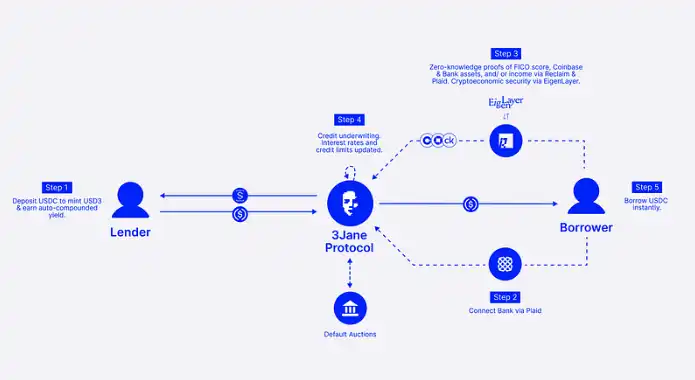
3Jane evaluates your on-chain credit through CredProtocol and BlockchainBureau, analyzing activities such as borrowing, liquidation, holding, and exchange interactions on the EVM chain to determine whether you are a prime user or a high-risk player. These scoring systems have been widely used in the DeFi space, and their risk identification capabilities are relatively reliable.
In addition to on-chain records, 3Jane can also access your Transunion, Equifax credit scores, and CreditKarma records through ReclaimProtocol and EigenLayer (such as credit card usage and delinquency history), without affecting your credit inquiry records and without the need for providing an SSN. This allows for a more comprehensive view of your borrowing credit, beyond just looking at on-chain data.
Through a dual on-chain and off-chain credit system, 3Jane ensures that loans are provided to truly trustworthy users, rather than "borrow and run" players.
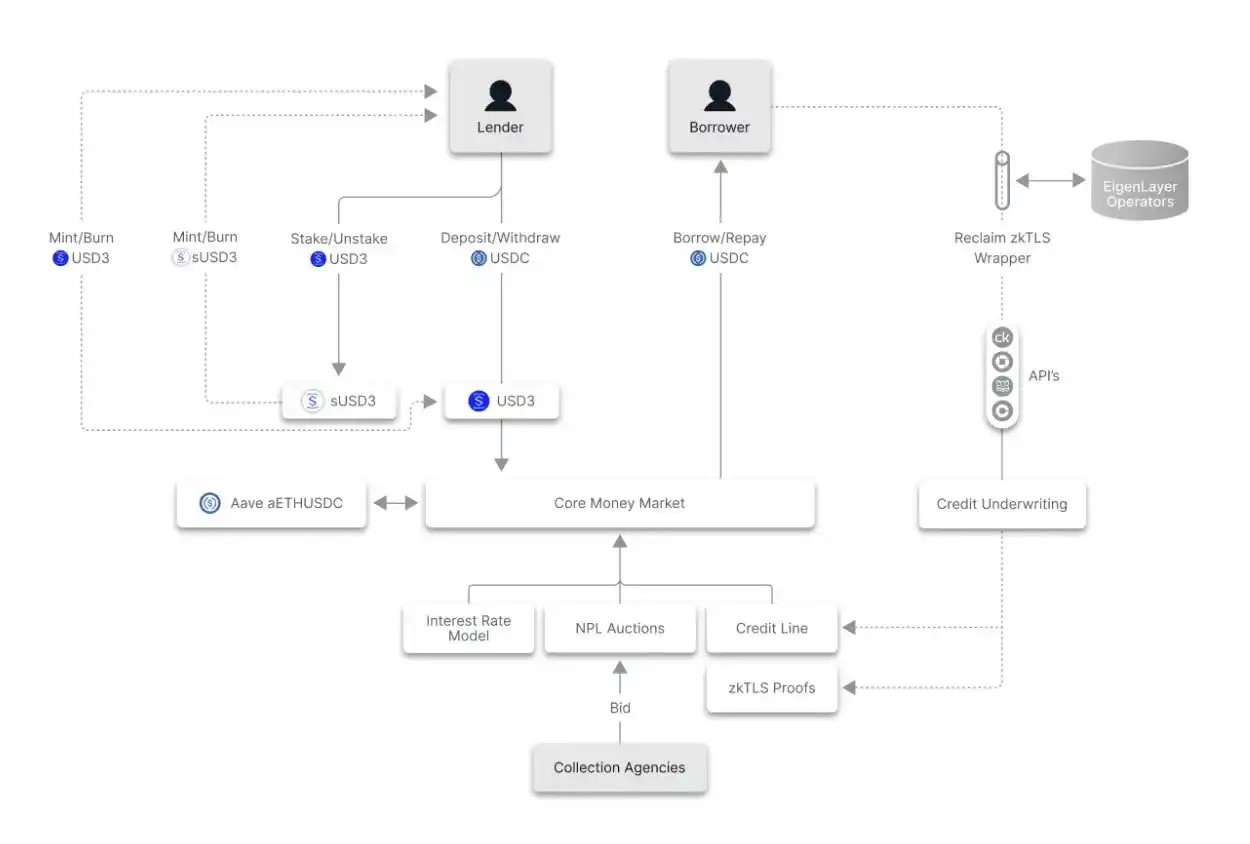
In case someone defaults on their loan, 3Jane binds users' bank account data to their Ethereum address through Plaid, providing minimal personal information, encrypting bank data end-to-end, and allowing for its deletion after repayment. Alternatively, if you default, 3Jane will directly auction off the non-performing loan on-chain, allowing U.S. debt collection agencies to take over. Ethereum smart contracts ensure a permanent and trustworthy commitment to off-chain collections, leaving an immutable default record. This mechanism increases the success rate of recovery.
How to Repay?
3Jane's repayment rules are much more flexible than traditional loans. You only need to pay the minimum amount each month, and the calculation method is quite unique—it will choose the lower of two options: if your on-chain and off-chain assets plus cash flow have increased since borrowing, you will repay based on this appreciation amount. If your assets have not performed well, you will repay based on the principal repayment ratio + interest set by 3Jane. As long as your financial situation is stable, market fluctuations will not make you unable to repay your debt.
If your assets have depreciated, 3Jane may have considered this risk when lending. However, if you have not made repayment by the grace period, you will enter the default period, during which additional late fees will be charged.
In summary: the repayment method is flexible, but there's no escape for defaulters!
Founder's Future Insights
3Jane was founded by @_yakovsky, who previously worked at RibbonFinance (later merged into Aevo) for three years. He initially joined as a smart contract engineer and later transitioned to growth strategy, departing in April 2024 to start 3Jane. There is currently limited information available about the rest of the team's background.

Initially, the 3Jane project was planned to be built on the Base Network, but the latest whitepaper only mentions Ethereum, perhaps due to considerations of liquidity and ecosystem maturity. @_yakovsky tweeted that uncollateralized loans are key to DeFi's mainstream adoption. If Ethereum aims to become a true "internet-native financial system," it must break free from reliance on bank liquidity and support the lending market with future value rather than existing assets. This concept has also been endorsed by Circle co-founder Jeremy Allaire, bringing more attention to 3Jane in the DeFi space.
Although 3Jane is still in its early stages with limited team information, its combination of credit lending, on-chain stablecoin, and off-chain recovery model demonstrates significant potential to reshape the DeFi ecosystem. Whether it's the vision of its founder @_yakovsky or the endorsement from Circle co-founder Jeremy Allaire, it indicates the market's anticipation for uncollateralized DeFi lending.
However, the ultimate question remains: Can 3Jane truly operationalize this model? Will the credit system of DeFi lending withstand market tests? Or is this just another highlight reel in the crypto market? All of these questions can only be answered with time.
You may also like

Former ByteDance employee's account: How I started with two Pinduoduo hard drives and made six times the profit with Seagate to achieve financial freedom?
MiCA reshuffle begins, Binance temporarily bids farewell to the EU
How does Gate redo "buying and selling stocks" from the cryptocurrency world to the stock market?
Visa and Mastercard join 140 giants to launch a new stablecoin, but the impact on the market landscape may still be limited
Circle CEO responds to OUSD's challenge: Stablecoins are a winner-takes-all business, and we will not slow down
Argentina vs Cape Verde: When a Record-Breaking Legend Meets an Unbreakable Underdog
WEEX exclusive pre-match analysis of Argentina vs Cape Verde, exploring Messi-led Argentina’s dominance and Cape Verde’s historic defensive breakout, with a breakdown of volatility, structure, and match dynamics.
WEEX Launches Depth Chart for Spot Trading
Raising interest rates to protect STRC and selling coins to maintain credit, this time the strategy has chosen the two most expensive paths
Morning Report | Samsung announces a 265.5 trillion won investment plan, focusing on semiconductor and AI computing power data centers; Vitalik publishes an article detailing the entire technology tree behind the confusion protocol (iO) mainline
In the era of AI, what is left of Bitcoin?
NeoSoul announced plans to integrate with the OKX Agentic Wallet, promoting AI agents' participation in the on-chain economy
Why Is Bitcoin Lagging Stocks in 2026? AI Stocks, ETF Outflows, and the Nasdaq Rally Explained
What you bought on CEX is really not US stocks: Analyzing the 94% liquidation monopoly and the evaporation of equity under a five-layer pipeline
In such a crowded cross-border payment arena, where is the next stop for the future?
Why Is Bitcoin Down in 2026? What We Can Learn From 2022
The large models in the United States are moving towards closure in the name of security
From the white-haired stock god to the billionaire fund mogul, the smart people shorting Nvidia are all getting rich using the same framework
Morning Report | CoinEx becomes a key hub for Iran to evade sanctions, involving over $3.8 billion in funds; Kalshi seeks a new round of financing, with a valuation potentially rising to $40 billion
Former ByteDance employee's account: How I started with two Pinduoduo hard drives and made six times the profit with Seagate to achieve financial freedom?
MiCA reshuffle begins, Binance temporarily bids farewell to the EU
How does Gate redo "buying and selling stocks" from the cryptocurrency world to the stock market?
Visa and Mastercard join 140 giants to launch a new stablecoin, but the impact on the market landscape may still be limited
Circle CEO responds to OUSD's challenge: Stablecoins are a winner-takes-all business, and we will not slow down
Argentina vs Cape Verde: When a Record-Breaking Legend Meets an Unbreakable Underdog
WEEX exclusive pre-match analysis of Argentina vs Cape Verde, exploring Messi-led Argentina’s dominance and Cape Verde’s historic defensive breakout, with a breakdown of volatility, structure, and match dynamics.