
Pectra Upgrade Takes First Step, What Upgrades are Coming to Ethereum?

Original Title: Pectra Upgrade Takes First Step, What Updates Will Ethereum See?
Original Author: Francesco
Original Translator: Luffy, Foresight News
The next Ethereum upgrade, Pectra, has taken its first step.
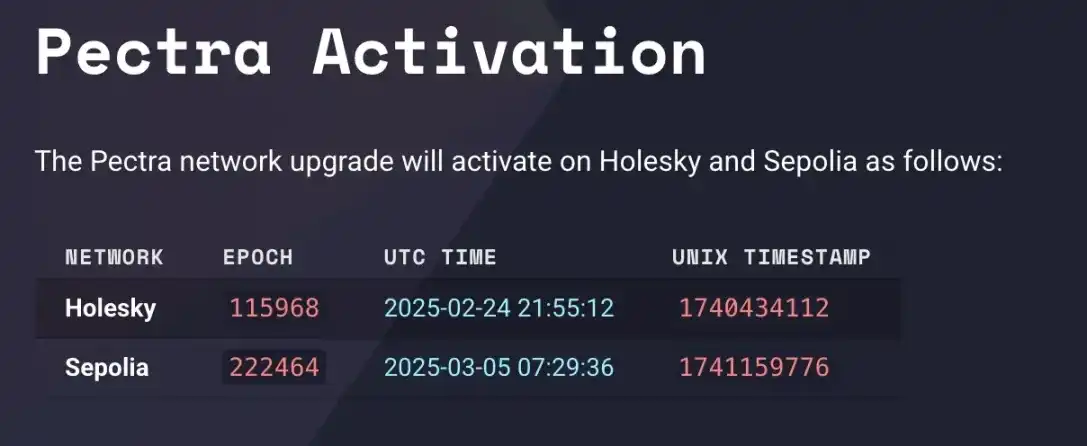
On February 24, the Pectra upgrade went live on the Holesky testnet; on March 5, Pectra will go live on the Sepolia testnet.
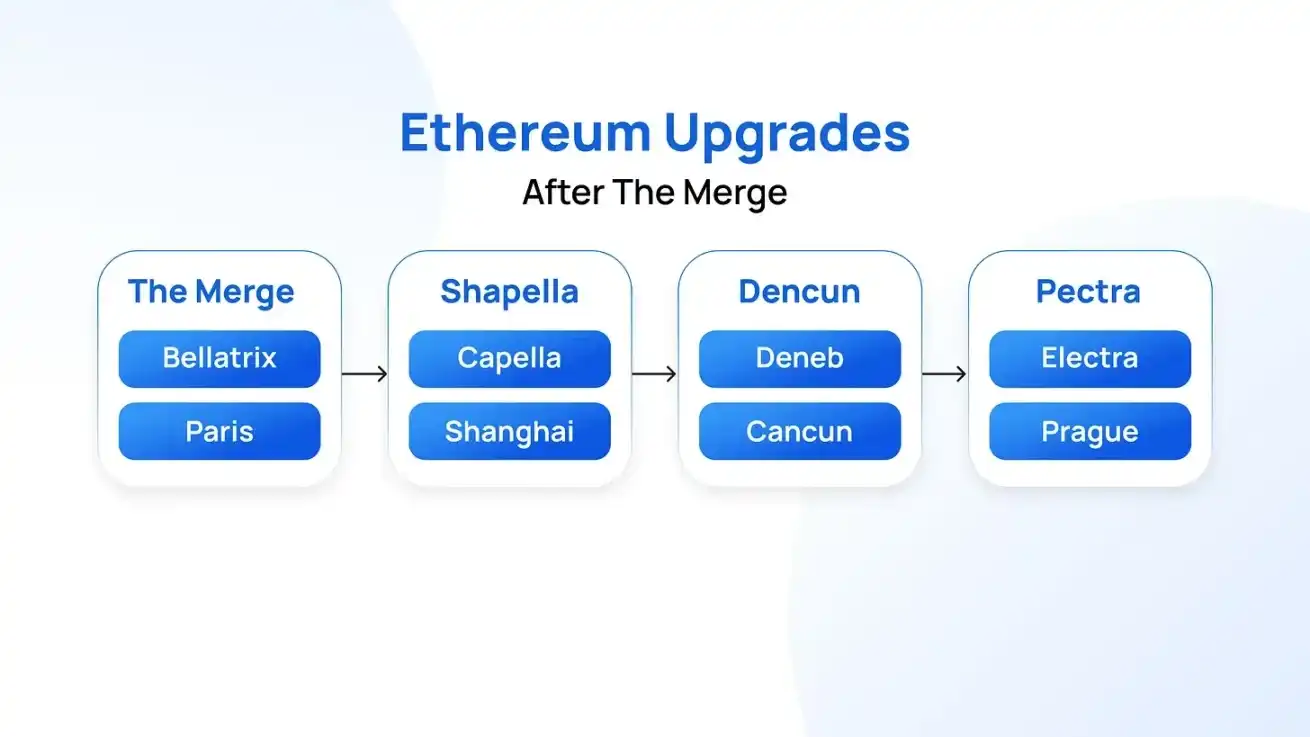
Once these upgrades are successfully implemented on the testnets, the mainnet upgrade date will be set, with the mainnet upgrade expected to take place within 3 to 9 months after the testnet implementation.
Pectra is a significant upgrade that introduces multiple Ethereum Improvement Proposals (EIPs) at once:
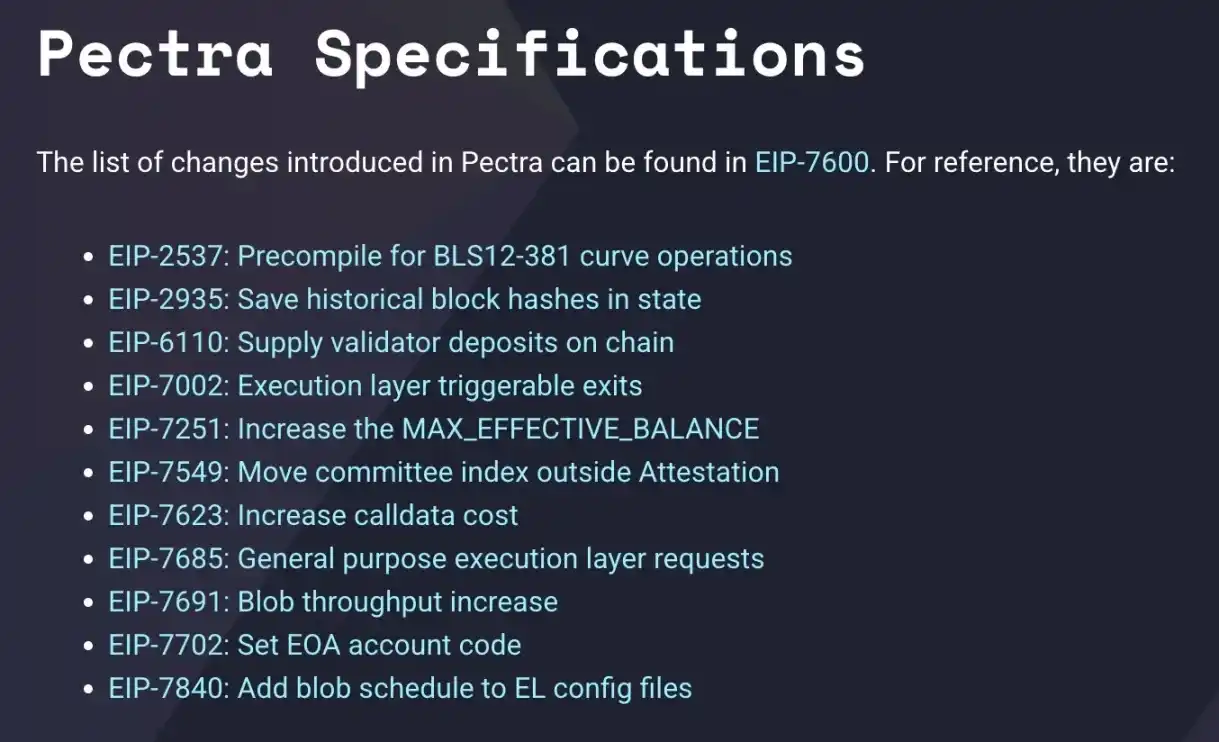
We can categorize these upgrades into three key areas:
· Enhancing Ethereum Accounts
· Improving the User Experience for Ethereum Validators
· Expanding the processing capability of "data blobs"
Let's delve into some of the upcoming Ethereum Improvement Proposals and how they will benefit the Ethereum protocol and users.
Enhancing Ethereum Accounts: EIP-7702
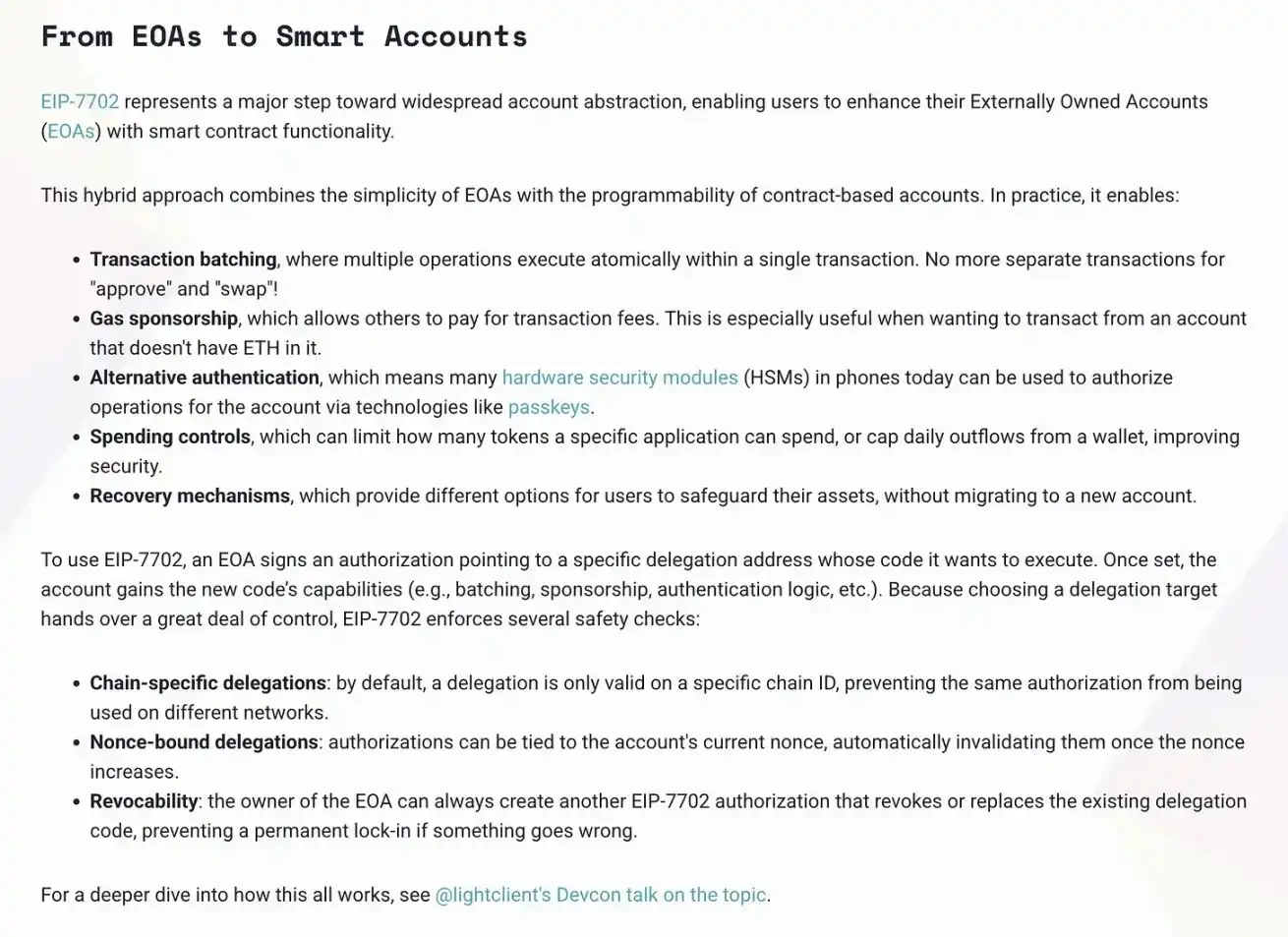 EIP-7702 brings Ethereum closer to an account abstraction experience at the protocol level. It achieves this by extending the functionality of Ethereum's externally owned accounts (EOAs) with features such as:
Transaction Batching: Executing multiple operations in a single transaction
Gas Fee Sponsorship: Allowing accounts with no ETH to have their gas fees sponsored by others
Additional authentication and recovery mechanisms
Enhancing the User Experience for Ethereum Validators: EIP-7251, EIP-7002, EIP-6110
EIP-7251: Increases the validator's maximum balance to 2048 ETH and enables automatic compounding of rewards for larger valid staking balances. Previously, rewards were calculated based on a 32 ETH balance only. Additionally, validators with larger stakes can now consolidate multiple 32 ETH validators into one.
EIP-7002: By setting the execution layer address to a "withdrawable credential", it is allowed to trigger a withdrawal operation, reducing reliance on trust. Previously, only validators could trigger exit operations.
EIP-6110: Eliminates the delay of up to 2048 blocks after validator deposits before being added to the queue. The expected wait time will shrink from 9 hours to 13 minutes.
Enhancing Processing Capabilities of "Data Blobs": EIP-7691
As the cost of "Blob" continues to rise, there is a need to enhance its processing capabilities. Through EIP-7691, the capacity of "Data Blobs" will increase by 50%: currently, each Ethereum block can hold approximately 3 "Data Blobs" on average (up to 6 during peak demand). With EIP-7691, the average number of "Data Blobs" a block can hold will increase to 6, reaching up to 9 during peak demand.
The next step in further expanding the processing capabilities of "Data Blobs" is to reduce the requirement to store all "Data Blobs" and move them to a subnet that can still be used to validate "Data Blob" data.
Other EIPs Included in the Pectra Upgrade
EIP-2537: Increases the security bits of operations from the current 80+ bits to over 120 bits.
EIP-2935: To accommodate the arrival of stateless clients, this proposal suggests storing historical block hash values as part of the block processing logic in the state. By achieving this through contract storage, EIP-2935 allows for a soft transition without impacting block hash logic. Layer 2 networks will be able to leverage longer historical data and query storage contracts directly.
EIP-7549: This proposal aims to improve the efficiency of the Casper client. It achieves this by reducing the number of pairings required for consensus validation. Specifically, it removes one of the three elements in the Casper client proof message: the committee index. By removing this element from the proof message, it is now possible to more efficiently aggregate consensus votes into a block, increasing the number of votes per block from 2 epochs to 8 epochs.
EIP-7623: The proposal to increase the cost of call data outlined in EIP-7623 is one of the most impactful upgrades (especially for Layer 2 networks). The proposal aims to adjust the cost of call data to address the discrepancy between average block size (100 kb) and maximum block size (7.15 MB). This will not affect regular users but will involve transactions primarily used for data publication. The cost increase will be achieved through a base fee that depends on the Gas fee proportion spent on call data operations: this can be accomplished by reducing block size to accommodate more "Data Blobs" or by increasing the Gas limit.
EIP-7685: Introduces a framework for storing requests triggered by smart contracts. This allows validator operations controlled by smart contracts to delegate management operations to the smart contract, reducing the need for intermediaries.
EIP-7840: Introduces a method to "dynamically adjust the target and maximum 'data Blob' per block for each block" through a "blobSchedule" object, instead of passing all values through an API.
This upgrade sends a clear signal for Ethereum. We know these upgrades have been scheduled long ago and are not a response to recent criticism. Nevertheless, this upgrade focuses on making the Ethereum network more secure, improving Ethereum accounts, and expanding the processing capabilities of 'data Blobs,' which aligns with some of the most critical development needs.
You may also like

Raising interest rates to protect STRC and selling coins to maintain credit, this time the strategy has chosen the two most expensive paths
Morning Report | Samsung announces a 265.5 trillion won investment plan, focusing on semiconductor and AI computing power data centers; Vitalik publishes an article detailing the entire technology tree behind the confusion protocol (iO) mainline
In the era of AI, what is left of Bitcoin?
NeoSoul announced plans to integrate with the OKX Agentic Wallet, promoting AI agents' participation in the on-chain economy
Why Is Bitcoin Lagging Stocks in 2026? AI Stocks, ETF Outflows, and the Nasdaq Rally Explained
What you bought on CEX is really not US stocks: Analyzing the 94% liquidation monopoly and the evaporation of equity under a five-layer pipeline
In such a crowded cross-border payment arena, where is the next stop for the future?
Why Is Bitcoin Down in 2026? What We Can Learn From 2022
The large models in the United States are moving towards closure in the name of security
From the white-haired stock god to the billionaire fund mogul, the smart people shorting Nvidia are all getting rich using the same framework
Morning Report | CoinEx becomes a key hub for Iran to evade sanctions, involving over $3.8 billion in funds; Kalshi seeks a new round of financing, with a valuation potentially rising to $40 billion
Global Launch: As predictions become the most scarce asset in the AI era, Manadia is defining the next generation of the value internet
Why do cryptocurrency projects always like to change their names?
Who is footing the bill for the $64 billion accounting frenzy?
I never expected that the first application of AI x Crypto would be in security auditing
What is your view on Binance's competitive advantages?
ETH has entered a non-consensus phase, and the turning point is approaching!
The shift in the cloud of the air: from despising stablecoins a year ago to the high-profile entry of capital today
Raising interest rates to protect STRC and selling coins to maintain credit, this time the strategy has chosen the two most expensive paths
Morning Report | Samsung announces a 265.5 trillion won investment plan, focusing on semiconductor and AI computing power data centers; Vitalik publishes an article detailing the entire technology tree behind the confusion protocol (iO) mainline
In the era of AI, what is left of Bitcoin?
NeoSoul announced plans to integrate with the OKX Agentic Wallet, promoting AI agents' participation in the on-chain economy
Why Is Bitcoin Lagging Stocks in 2026? AI Stocks, ETF Outflows, and the Nasdaq Rally Explained
What you bought on CEX is really not US stocks: Analyzing the 94% liquidation monopoly and the evaporation of equity under a five-layer pipeline