
Deep Dive into BTC On-chain Analysis: Where is the Short-Term Bottom?


Original Author: Murphy, On-chain Data Analyst
Chip Structure Determines the Lower Limit of BTC Price Pullback
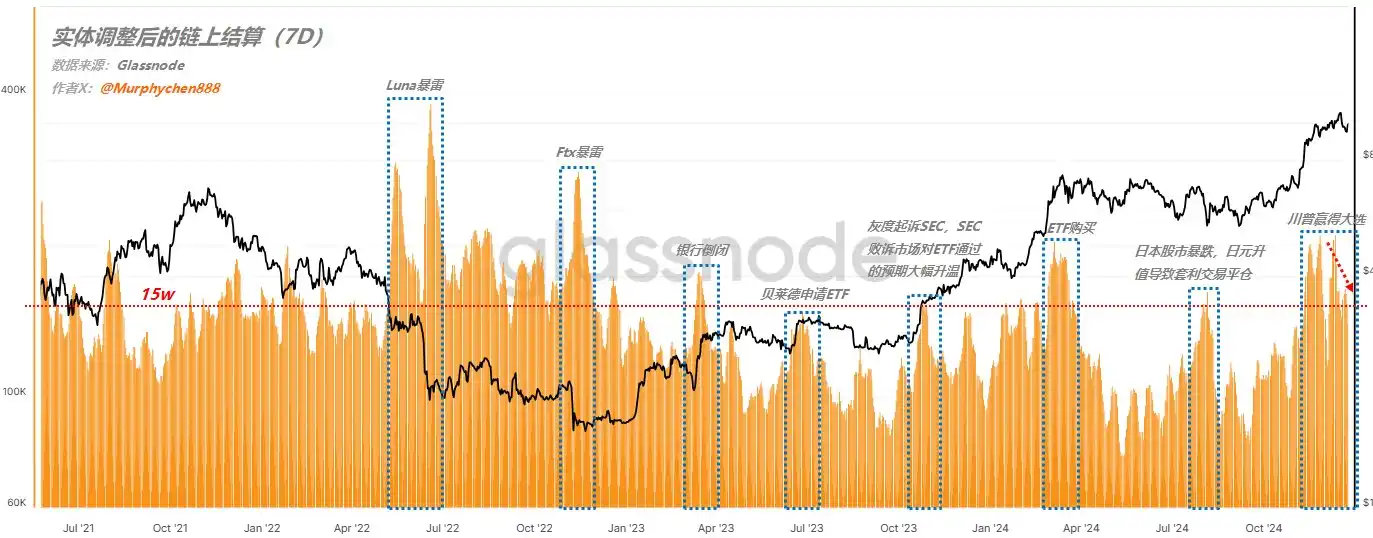
Every event that drives market sentiment change is accompanied by a sudden surge in on-chain transaction volume. After data filtering to exclude transfers within the same entity address cluster, the daily on-chain actual transaction volume is usually around 100k BTC (7-day average), with more on weekdays and less on weekends; if it exceeds 150k BTC, it is considered an "abnormal" data point.
For example, the Luna flash crash in May 2022, the FTX flash crash in November 2022, and the collapse of U.S. banks such as Silicon Valley Bank and Signature Bank from March to April 2023 all brought extreme panic and anxiety to the market, with on-chain transaction volume peaking at over 300k BTC (see Figure 1).
(Figure 1)
From this perspective, we should no longer doubt whether on-chain data can truly reflect "transaction" behavior. It can even be considered that BTC's on-chain settlement is the barometer of the entire crypto market's activity level and a quantified form of macro sentiment.
We can see that after November, as Trump won the presidential election, market sentiment reached a climax, with daily settlement volume reaching 200k. In this round of the cycle, a similar level was only seen in March of this year, indicating a large influx of capital in the short term. However, after December 17, the sentiment began to noticeably cool down, with the average daily settlement volume dropping to around 120k by the 25th. Historically, after experiencing a peak period, the ebb of activity also means that the market enters a period of calm, which is also the most vulnerable time for a pullback to occur.
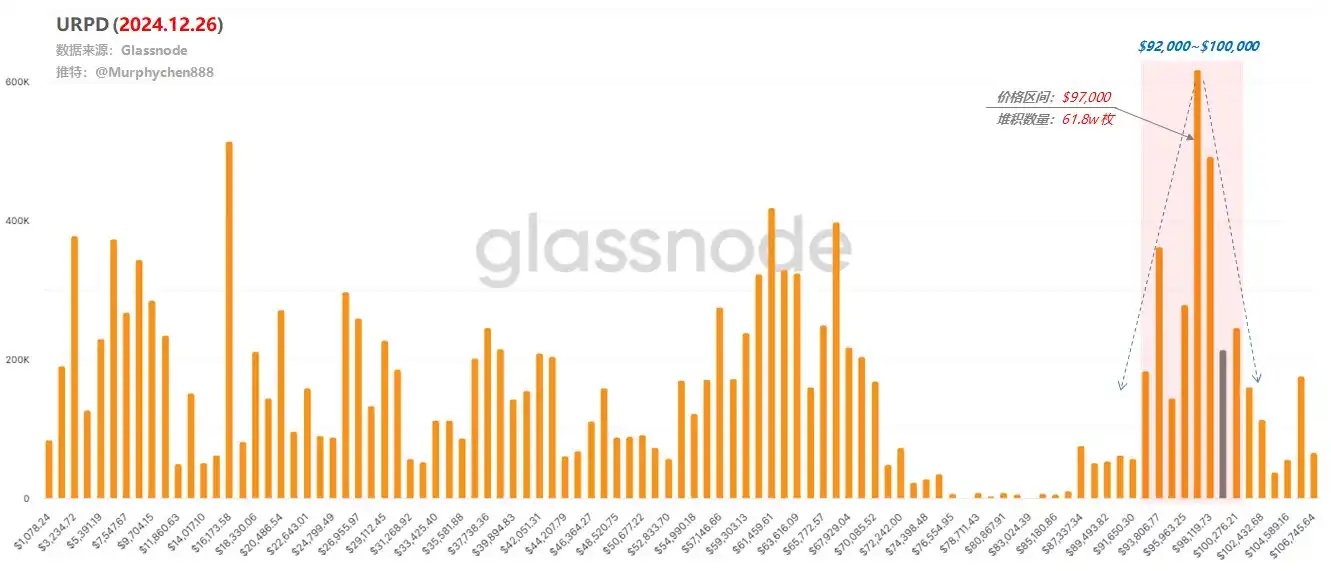
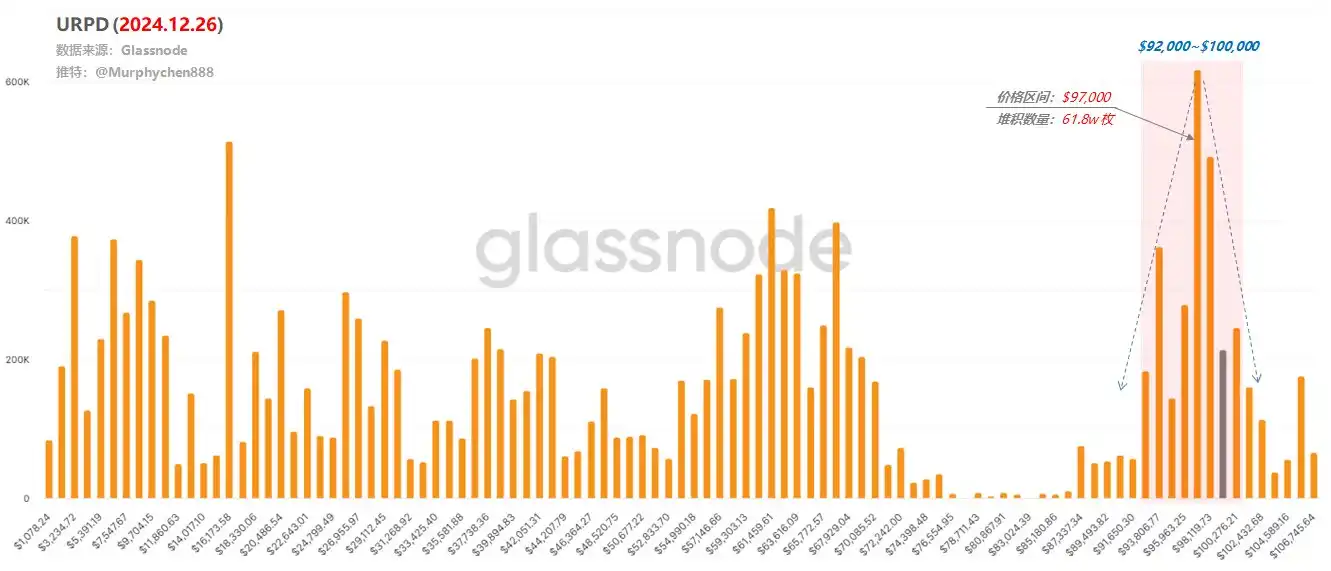
By tracking UTXOs and differentiating on-chain transactions based on different realized prices, we can derive a highly intuitive set of chip structure distribution data, known as URPD (see Figure 2).
(Figure 2)
From the current data, the on-chain structure is gradually forming a chip accumulation zone in the $92,000 to $100,000 range, with a massive 600k BTC volume column at $97,000 as the peak, decreasing on both sides.
The Appearance of a Massive Volume Candle Indicates 2 Points:
1. The high likelihood that this is not the absolute top price of the bull market cycle.
2. The price range has experienced intense long and short positioning battles, with a large amount of turnover leading to chip stacking.
Where there are sellers, there are buyers. This indicates that some people here believe the price will continue to drop and want to hedge, while others believe the price at this level presents a good buying opportunity. It is precisely because of the significant buying behavior that the $92,000 to $100,000 range has established a strong support effect. This is why we say that the chip stacking zone has a "damping effect" on the price, meaning that the price will face resistance when trying to break through (difficult to penetrate), and there will be gravitational forces pulling the price back when it moves away.
If it is a major cycle top, there usually won't be much dissent, only "consensus." When the majority of participants reach a consensus that the price is "too high," naturally, there will be more selling than buying, and the market will naturally "peak." Therefore, dissent is not necessarily a bad thing; it is a necessary process for the market to self-correct.
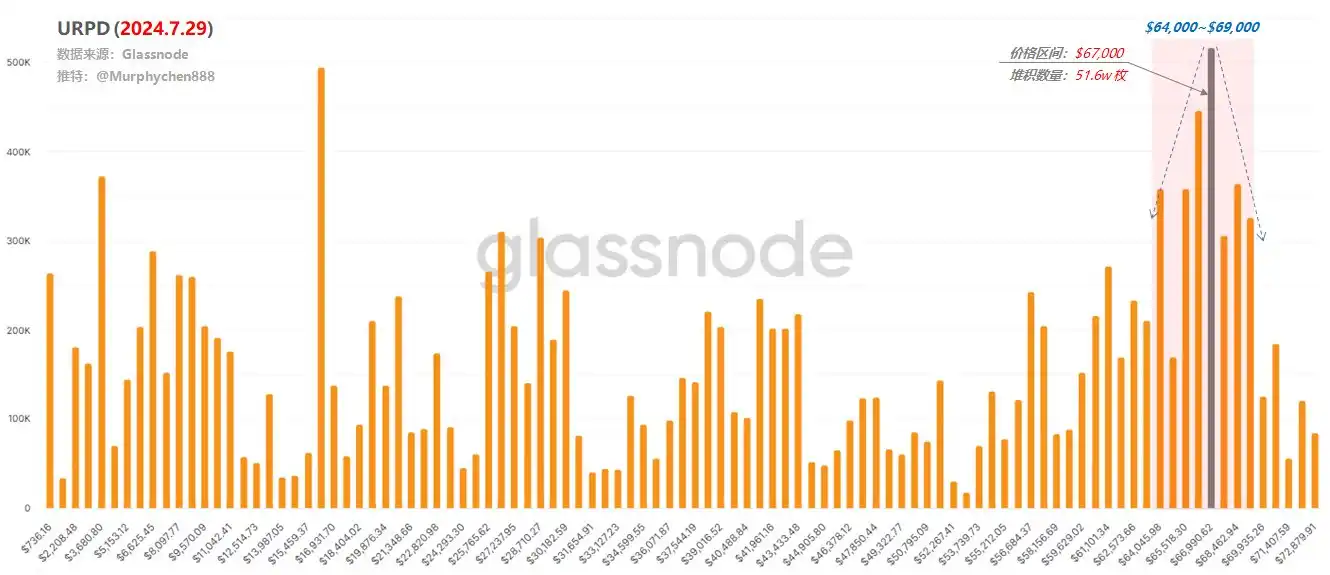
If we must provide an example, a similar chip structure also emerged in July-August 2024 (as shown in Figure 3).
(Figure 3)
At that time, a chip stacking zone was formed in the $64,000 to $69,000 range, with a massive volume candle of 52k BTC created at $67,000 as the peak, gradually decreasing towards both sides, forming a regional price support. I believe everyone still remembers that for a long time after this, the price of BTC did not fall below this price range. Even when it started moving away from this range on August 5 and September 7, the chip structure in this range remained intact. After some time, the price of BTC will return to this range (experiencing gravitational pull).
If we compare the current structure with the horizontal structure in July, the patterns are very similar, but the current one is not as robust yet. Nevertheless, it has already shown a clear support role. Over time, as the turnover becomes more extensive here, the support effect will be stronger. Of course, if the price continues to break upwards, unless it surges quickly away from this price range, it will also be constrained by "gravity" (short-term high-level chips will create massive selling pressure).
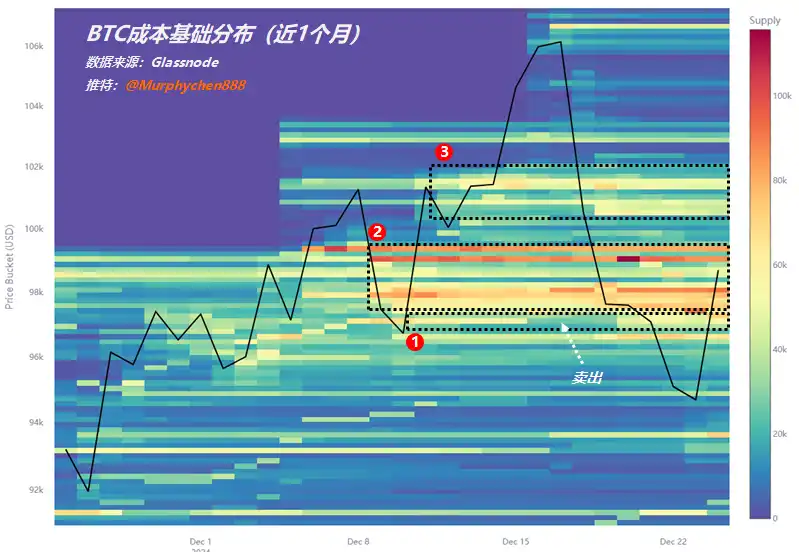
We can also observe similar conclusions from CBD data from another perspective (as shown in Figure 4).
(Figure 4)
Unlike the URPD, which tracks the analysis of the original UTXO, the CBD (BTC Cost Basis Distribution) conducts data calculations per address. It better represents the overall behavior of network participants and can clearly display the trend of cost basis changes over time.
From Figure 4, we can see that as the BTC price retraced to below $100,000 on 12/8, the color changed from green to red, indicating an increase in the money supply (see Point 2). This suggests that a significant amount of bottom-fishing behavior occurred at that time. The chips bought during this period did not show a significant decrease even after the rebound on 12/16 and the subsequent fall on 12/23, with the cost basis remaining around $97,000-$100,000, forming effective support.
Additionally, the chips bought at the low point of $96,000 during the retracement on 12/10 were sold when the price rebounded to $105,000 on 12/16, causing the color to change from red to green (see Point 1). However, when the price retraced again to around $96,000 on 12/21, funds started to buy in. This group is likely engaged in short-term swing trading and represents the main group of on-chain turnover in recent days (STH).
The remaining chips trapped at high prices between $100,000 and $102,000 also account for a significant portion, but they are relatively firm in their positions. Currently, there is no significant decrease in their numbers.
In conclusion, the current market sentiment is gradually calming down, and liquidity is decreasing. However, the chip structure remains "healthy," with the price support formed in the $92,000-$100,000 range proving to be effective. As time passes and turnover increases, the support will strengthen (determining the lower limit). Whether we can see a new all-time high or reverse the trend decline will depend on the market's expectations of macro policies after entering January of the 25th year.
This content is for communication and research purposes only and should not be considered investment advice.
You may also like

The large models in the United States are moving towards closure in the name of security

Morning Report | CoinEx becomes a key hub for Iran to evade sanctions, involving over $3.8 billion in funds; Kalshi seeks a new round of financing, with a valuation potentially rising to $40 billion

From the white-haired stock god to the billionaire fund mogul, the smart people shorting Nvidia are all getting rich using the same framework

Why do cryptocurrency projects always like to change their names?

Global Launch: As predictions become the most scarce asset in the AI era, Manadia is defining the next generation of the value internet

Who is footing the bill for the $64 billion accounting frenzy?
I never expected that the first application of AI x Crypto would be in security auditing

What is your view on Binance's competitive advantages?

ETH has entered a non-consensus phase, and the turning point is approaching!
The shift in the cloud of the air: from despising stablecoins a year ago to the high-profile entry of capital today
The survival dilemma of small and medium exchanges behind the withdrawal anomalies exposed by AscendEX
Why Is Bitcoin Falling Below $60K? 5 Key Market Drivers Explained
Bitcoin has dropped sharply amid ETF outflows, Strategy stock weakness, AI stock rallies, and changing Fed expectations. Explore the key forces driving BTC’s latest correction and what traders should watch next.

Bitcoin vs. Gold in 2026: Which Asset Performs Better in Different Markets?

Morning News | The draft amendment to the People's Bank of China Law aims to clarify the legal status of digital renminbi; South Korea will transfer about 40 unregistered virtual asset service providers to law enforcement agencies
The cryptocurrency industry has entered the "Show Me" era: merely relying on vision is no longer enough

Interpreting the Ethereum Foundation's new structure: Reaffirming self-sovereignty amid institutional trends
Former SpaceX engineer reconstructs the financial execution system using first principles
Standard Chartered Bank sings a 50x rhapsody again, aiming for AAVE to reach 3500 USD
The large models in the United States are moving towards closure in the name of security
Morning Report | CoinEx becomes a key hub for Iran to evade sanctions, involving over $3.8 billion in funds; Kalshi seeks a new round of financing, with a valuation potentially rising to $40 billion
From the white-haired stock god to the billionaire fund mogul, the smart people shorting Nvidia are all getting rich using the same framework
Why do cryptocurrency projects always like to change their names?
Global Launch: As predictions become the most scarce asset in the AI era, Manadia is defining the next generation of the value internet
Who is footing the bill for the $64 billion accounting frenzy?


