
Can the Uniswap Foundation's massive investment plan solve the token value capture dilemma?



Original Title: Uniswap Foundation votes on a massive $165.5m USD funding.
Original Author: Ignas
Original Translation: Tim, PANews
The Uniswap Foundation has voted on a $165.5 million USD investment plan, but why?
Because the performance of Uniswap v4 and Unichain post-release has fallen far short of market expectations.
In over a month:
· Uni v4's Total Value Locked (TVL) is only $85 million
· Unichain's TVL is only $8.2 million
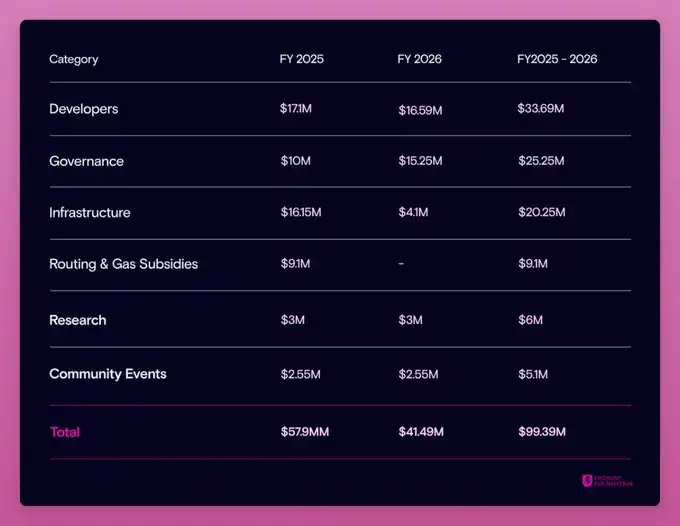
To drive growth, the Uniswap Foundation has proposed allocating $165.5 million in funding towards the following:
· $95.4 million for Grants (developer initiatives, core contributors, validators);
· $25.1 million for Operations (team expansion, governance tooling);
· $45 million for Liquidity Incentives.
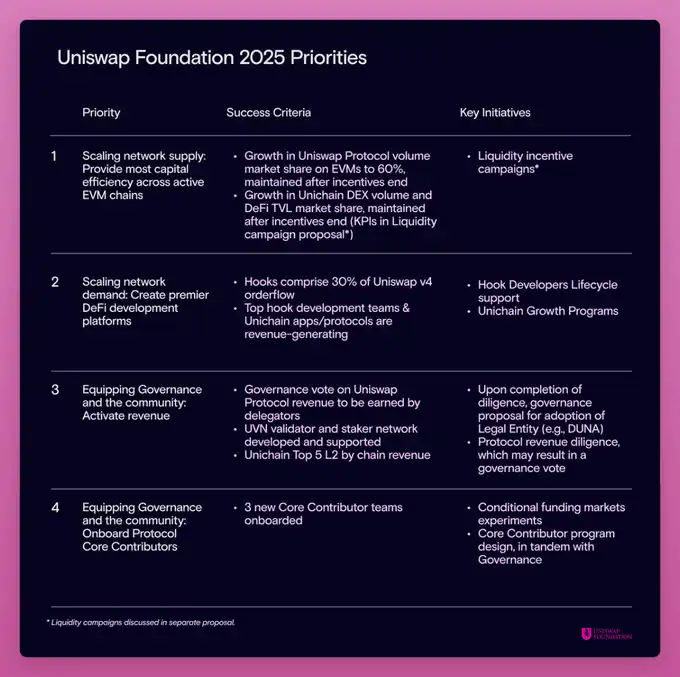
As you can see, Uni v4 is not just a DEX but also a liquidity platform, and Hooks are applications built on top of it.
Hooks are meant to drive the ecosystem growth of Uni v4, hence the need to accelerate this process through a funding initiative.
A breakdown of the funding budget:
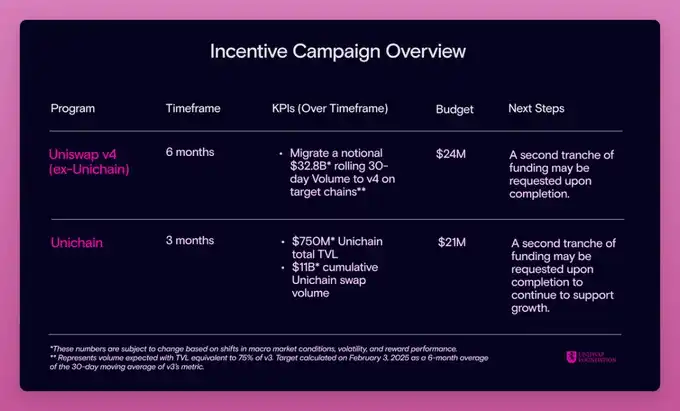
The $45 million Liquidity Provider (LP) Incentives will be used as follows:
· $24 million (distributed over 6 months): To incentivize liquidity migration from other platforms to Uni v4;
· $21 million (distributed over 3 months): To drive Unichain's Total Value Locked (TVL) from the current $8.2 million to $750 million.
On the other hand, Aerodrome mints approximately $40-50 million worth of AERO tokens per month for Liquidity Provider (LP) incentives.
The proposal has passed the temperature check phase but still faces some criticism:
Amidst industry shifts, Aave proposes a weekly buyback of $1 million worth of AAVE tokens, Maker plans a monthly buyback of $30 million, and UNI holders are likened to a "cash cow" that has never had its token value captured.
UNI tokens do not enable a fee-sharing mechanism, yet Uniswap Labs has earned $171 million over two years through frontend fees.
The key to the whole system lies in Uniswap's organizational design:
· Uniswap Labs: Focuses on protocol tech development;
· Uniswap Foundation: Drives ecosystem growth, governance, and funding initiatives (such as grants, liquidity incentives).
Quite a savvy legal team.
Aave and Maker have established a closer alignment of interests with token holders, and I don't understand why Uniswap's frontend fees cannot be shared with UNI holders.
In conclusion, other criticisms mainly revolve around the core team's high salaries, Gauntlet's responsibility for liquidity incentive execution, and the establishment of a new centralized DAO legal structure (DUNA).
As a small governance representative for Uniswap, I have voted in favor of this proposal, but I still have significant concerns about the future of UNI holders: the incentive mechanism has failed to align with holders' interests.
However, I am a loyal fan of Uniswap and highly appreciate its driving role in the DeFi space. The current stagnation of Uni v4 and Unichain is very concerning, and they need to introduce incentive measures to foster development.
The next Uni DAO vote should focus on the UNI token's value-capture mechanism.
You may also like

Argentina vs Cape Verde: When a Record-Breaking Legend Meets an Unbreakable Underdog
WEEX exclusive pre-match analysis of Argentina vs Cape Verde, exploring Messi-led Argentina’s dominance and Cape Verde’s historic defensive breakout, with a breakdown of volatility, structure, and match dynamics.
How does Gate redo "buying and selling stocks" from the cryptocurrency world to the stock market?
Former ByteDance employee's account: How I started with two Pinduoduo hard drives and made six times the profit with Seagate to achieve financial freedom?
Visa and Mastercard join 140 giants to launch a new stablecoin, but the impact on the market landscape may still be limited
WEEX Launches Depth Chart for Spot Trading
MiCA reshuffle begins, Binance temporarily bids farewell to the EU
Raising interest rates to protect STRC and selling coins to maintain credit, this time the strategy has chosen the two most expensive paths
Morning Report | Samsung announces a 265.5 trillion won investment plan, focusing on semiconductor and AI computing power data centers; Vitalik publishes an article detailing the entire technology tree behind the confusion protocol (iO) mainline
In the era of AI, what is left of Bitcoin?
NeoSoul announced plans to integrate with the OKX Agentic Wallet, promoting AI agents' participation in the on-chain economy
Why Is Bitcoin Lagging Stocks in 2026? AI Stocks, ETF Outflows, and the Nasdaq Rally Explained
What you bought on CEX is really not US stocks: Analyzing the 94% liquidation monopoly and the evaporation of equity under a five-layer pipeline
In such a crowded cross-border payment arena, where is the next stop for the future?
Why Is Bitcoin Down in 2026? What We Can Learn From 2022
The large models in the United States are moving towards closure in the name of security
From the white-haired stock god to the billionaire fund mogul, the smart people shorting Nvidia are all getting rich using the same framework
Morning Report | CoinEx becomes a key hub for Iran to evade sanctions, involving over $3.8 billion in funds; Kalshi seeks a new round of financing, with a valuation potentially rising to $40 billion
Global Launch: As predictions become the most scarce asset in the AI era, Manadia is defining the next generation of the value internet
Argentina vs Cape Verde: When a Record-Breaking Legend Meets an Unbreakable Underdog
WEEX exclusive pre-match analysis of Argentina vs Cape Verde, exploring Messi-led Argentina’s dominance and Cape Verde’s historic defensive breakout, with a breakdown of volatility, structure, and match dynamics.
How does Gate redo "buying and selling stocks" from the cryptocurrency world to the stock market?
Former ByteDance employee's account: How I started with two Pinduoduo hard drives and made six times the profit with Seagate to achieve financial freedom?
Visa and Mastercard join 140 giants to launch a new stablecoin, but the impact on the market landscape may still be limited
WEEX Launches Depth Chart for Spot Trading
MiCA reshuffle begins, Binance temporarily bids farewell to the EU


